

What To Use To Fix A Hole In My Drywall

Repairing drywall is a skill that every thrifty homeowner should have on their resume. It's not complicated, doesn't require specialty tools, and takes just a piffling time.
After the initial shock of breaking a 6-inch or larger hole in a wall, you may at first think it's a task for a professional person. That might non actually be the instance. If you're a DIYer with a few bones hand tools, there's no demand to hire out this project. You tin can tackle the chore in just a 24-hour interval or ii (including drying fourth dimension), and you'll spend less than $100 on materials to practise information technology.
How to repair drywall: small holes, cracks, and dents
If that heavy pic pulled your screw through the drywall or years of onetime nail holes are starting to build upwardly, requite them a quick affect-up using just a few, cheap tools.
What you'll need:
- Quick-drying spackle
- Putty knife
- Sandpaper with a fine grit
How to repair:
- Fill the hole or crack with quick-drying spackle using a putty knife.
- Allow the spackle to dry for the amount of fourth dimension recommended by the manufacturer.
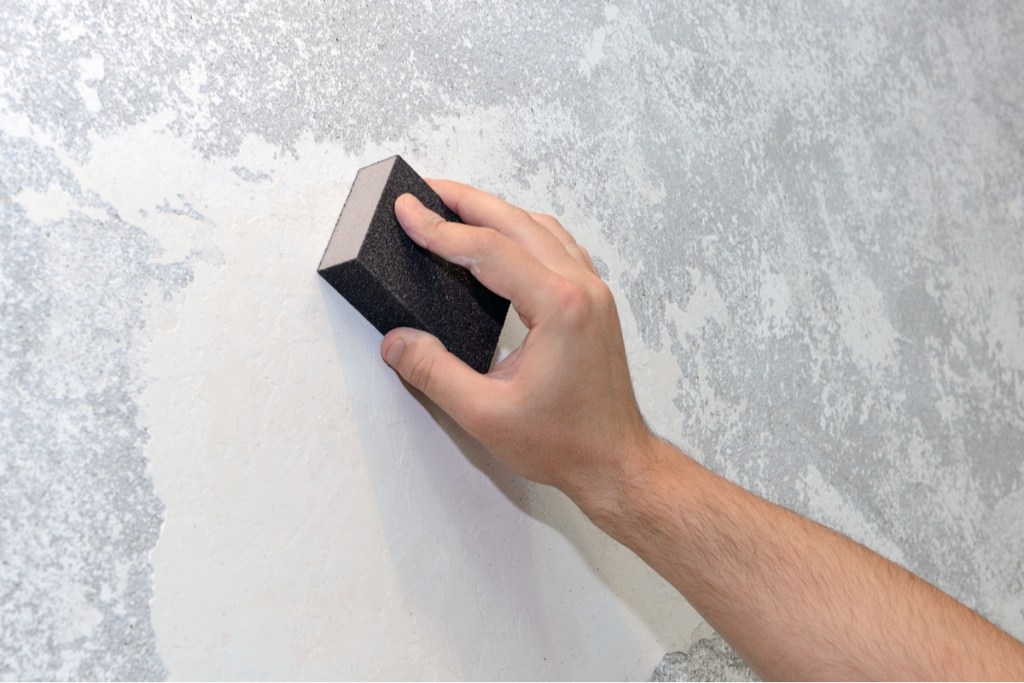
- In one case stale, lightly sand the area with your sandpaper to make it affluent with the residual of the wall.
- Proceed to prime number and paint the repaired expanse.
How to repair drywall: medium-sized holes
For holes that are under 4 inches in bore merely too large to make full with spackle, use a drywall repair kit. These kits typically include all of the tools you'll demand to consummate the repair on your own.
What you lot'll need:
- Mesh roofing with agglutinative
- Drywall spackle
- Drywall knife
- Sandpaper
How to repair:
- Apply the mesh covering over the hole completely so that it overlaps onto the wall by almost 1 inch on all sides.
- Employ a drywall knife to apply the spackle over the mesh, covering information technology completely. Be certain to apply the spackle equally thinly equally possible on the undamaged portions of drywall to forestall bulging.
- Allow the spackling compound to dry out for the recommended fourth dimension.
- Employ sandpaper to lightly sand down and smooth the entire spackled area.
- Go on to prime and paint the repaired area.
How to repair drywall: large holes
For larger holes in your drywall that are bigger than 4 inches in diameter, yous won't exist able to apply putty or spackle to repair them. When repairing larger drywall holes, you'll likely demand to cut out some of the existing drywall. For this stride, exist cautious and avert cutting any wires that run behind the walls. Typically, wires are attached to studs, so if the drywall hole is near a stud, call a professional for help.
What you'll demand:
- Tape measure
- Pencil
- Architect's square
- Drywall saw
- Wood saw
- Utility knife
- Cordless drill/driver with #2 Phillips-head screwdriver bit
- Drywall taping knife
- Sanding sponge, 150-grit
- Dust mask
- Vacuum cleaner
- Tack cloth
- Rag
- Paintbrush
- Paint roller, roller embrace, and pan
Project materials
- 1 ten 4 common board (length varies based on the size of the pigsty)
- one ¼ inch coarse threaded drywall screws
- Drywall, the same thickness as that to be repaired
- Self-adhesive mesh drywall record
- Drywall joint compound
- Primer
- Paint

How to repair:
Prepare the wall
Gently remove any loose, broken pieces of drywall. Look for wiring, pipes, or ductwork in the wall space backside the area that needs to be patched. If any of these are present, be careful non to impairment them during the repair. Next, use the builder's square and a pencil to mark straight lines but beyond the edges of the broken hole to foursquare it upward. Employ the drywall saw to carefully cutting out the excess pieces.
Install backer boards
Cut 2 backer boards out of a 1 10 4 board, near 4 inches longer than the long sides of the opening. Install the first backer board inside the wall and so that the face of the lath is centered on the edge of the opening, half behind the drywall and one-half exposed. Each finish should extend most 2 inches by the opening. Hold the backer board in place and secure it with drywall screws through the drywall and into the board. Space the screws 1-inch from the border of the drywall and half-dozen-inches autonomously. Sink the spiral heads slightly below the surface of the drywall. Repeat the installation process with the second backer board forth the contrary long edge of the opening.
Cut and install the drywall patch
Mensurate, mark, and cutting the drywall patch to the aforementioned dimensions as the opening. A lilliputian wiggle room is fine, just the gap between the patch and the existing drywall should exist ⅛-inch or less. Place the patch in position and spike information technology with more drywall screws. Space the screws 1 inch from the edge of the patch, and vi-inches autonomously.
Record the joints
Measure the lengths of the seams between the patch and the existing drywall, and use the utility knife cutting strips of mesh drywall tape. Record over the lengths of all the seams, overlapping the tape at the corners. Exist careful to avoid creating wrinkles and bubbles in the tape.
Mud the joints
Use the drywall knife to work a thin layer of joint chemical compound into the mesh tape. The texture of the mesh should still be visible. Allow the mud to dry out, then scrape it with the pocketknife to polish it out.
Apply a 2d thin layer of joint compound to further smooth the texture of the tape. Use the drywall pocketknife to plume out the moisture compound across the edges of the tape. Let it dry out, and scrape to smooth over again.
Apply a third and concluding layer of compound. Feather information technology out to blend with the surface of the wall beyond the patch, then let it dry.
Sand
Put on the dust mask and use the sanding sponge to smooth out the surface of the drywall compound, beingness thorough but non aggressive. Over-sanding will crusade the mesh tape to show through, which would so require you to re-mud, dry, and sand all over again. After sanding, clean upward the dust with a vacuum cleaner and wipe down the patch with the tack fabric.
Pigment
Apply the paintbrush to apply a coat of primer over the patched area. Let information technology dry thoroughly, and so use the roller to use ii or iii coats of paint to friction match the rest of the wall. For the best color match, paint the entire wall instead of but the repaired expanse.
To save big money on home repairs, learn to do the basics yourself. Repairing drywall is neither difficult, time-consuming, nor expensive, so it'south a perfect do-it-yourself project for thrifty homeowners.
Editors' Recommendations
- Thinking nigh installing sliding barn doors? 4 essential questions to ask yourself
- 6 times y'all should absolutely choose an eggshell pigment finish
- Why your home should have an areca palm (and how to intendance for it)
- How to install a security light with a motion sensor in three piece of cake steps
- How to prune a dracaena marginata (dragon tree) so your plant stays thriving

What To Use To Fix A Hole In My Drywall,
Source: https://www.21oak.com/home-maintenance/repair-drywall-hole/
Posted by: moorewhatelto44.blogspot.com
0 Response to "What To Use To Fix A Hole In My Drywall"
Post a Comment