

Aluminium Powder And Iron Oxide

A thermite mixture using fe (III) oxide
Thermite ()[1] is a pyrotechnic composition of metal pulverization and metal oxide. When ignited by rut or chemic reaction, thermite undergoes an exothermic reduction-oxidation (redox) reaction. Near varieties are not explosive, but can create brief bursts of heat and loftier temperature in a small surface area. Its course of activity is similar to that of other fuel-oxidizer mixtures, such every bit blackness pulverization.
Thermites have diverse compositions. Fuels include aluminum, magnesium, titanium, zinc, silicon, and boron. Aluminum is common considering of its high humid point and low cost. Oxidizers include bismuth(III) oxide, boron(III) oxide, silicon(Four) oxide, chromium(Three) oxide, manganese(IV) oxide, iron(III) oxide, iron(II,3) oxide, copper(Ii) oxide, and lead(Ii,IV) oxide.[ii]
The reaction, likewise called the Goldschmidt process, is used for thermite welding, frequently used to join railway tracks. Thermites take likewise been used in metallic refining, disabling munitions, and in incendiary weapons. Some thermite-like mixtures are used as pyrotechnic initiators in fireworks.
Chemical reactions [edit]

A thermite reaction using fe(Three) oxide. The sparks flying outwards are globules of molten iron abaft smoke in their wake.
In the following example, elemental aluminum reduces the oxide of another metallic, in this mutual case iron oxide, because aluminum forms stronger and more stable bonds with oxygen than fe:
- Fe2O3 + 2 Al → 2 Atomic number 26 + Al2O3
The products are aluminum oxide, elemental iron,[3] and a large corporeality of heat. The reactants are commonly powdered and mixed with a binder to keep the material solid and prevent separation.
Other metal oxides can be used, such as chromium oxide, to generate the given metal in its elemental class. For example, a copper thermite reaction using copper oxide and elemental aluminum can be used for creating electric joints in a process called cadwelding, that produces elemental copper (it may react violently):
- 3 CuO + 2 Al → three Cu + AltwoO3
Thermites with nanosized particles are described by a variety of terms, such as metastable intermolecular composites, super-thermite,[iv] nano-thermite,[v] and nanocomposite energetic materials.[6] [7] [viii]
History [edit]
The thermite (thermit) reaction was discovered in 1893 and patented in 1895 by German pharmacist Hans Goldschmidt.[9] [10] Consequently, the reaction is sometimes called the "Goldschmidt reaction" or "Goldschmidt process". Goldschmidt was originally interested in producing very pure metals by avoiding the utilize of carbon in smelting, but he soon discovered the value of thermite in welding.[eleven]
The start commercial application of thermite was the welding of tram tracks in Essen in 1899.[12]
Types [edit]

A thermite reaction taking place on a cast iron skillet
Red fe(Three) oxide (Fe2O3, normally known equally rust) is the most common iron oxide used in thermite.[13] [fourteen] [15] Magnetite as well works.[16] Other oxides are occasionally used, such as MnOtwo in manganese thermite, Cr2O3 in chromium thermite, quartz in silicon thermite, or copper(II) oxide in copper thermite, just only for specialized purposes.[sixteen] All of these examples use aluminum as the reactive metal. Fluoropolymers tin can be used in special formulations, Teflon with magnesium or aluminum being a relatively common example. Magnesium/teflon/viton is another pyrolant of this type.[17]
Combinations of dry out water ice (frozen carbon dioxide) and reducing agents such as magnesium, aluminum and boron follow the same chemical reaction equally with traditional thermite mixtures, producing metal oxides and carbon. Despite the very low temperature of a dry ice thermite mixture, such a system is capable of beingness ignited with a flame.[eighteen] When the ingredients are finely divided, bars in a pipage and armed similar a traditional explosive, this cryo-thermite is detonatable and a portion of the carbon liberated in the reaction emerges in the class of diamond.[19]
In principle, any reactive metal could be used instead of aluminum. This is rarely done, because the properties of aluminum are nearly ideal for this reaction:
- It is by far the cheapest of the highly reactive metals. For example, in December 2014, can was U.s.a.$19,829/metric ton, zinc was US$two,180/t and aluminum was US$1,910/t.[twenty]
- It forms a passivation layer making it safer to handle than many other reactive metals.[21]
- Its relatively low melting indicate (660 °C) means that it is easy to cook the metal, and then that the reaction can occur mainly in the liquid phase, thus information technology proceeds fairly quickly.
- Its high boiling point (2519 °C) enables the reaction to reach very high temperatures, since several processes tend to limit the maximum temperature to merely beneath the boiling point. Such a loftier humid point is common amidst transition metals (eastward.g., atomic number 26 and copper boil at 2887 and 2582 °C, respectively), but is especially unusual amidst the highly reactive metals (cf. magnesium and sodium, which boil at 1090 and 883 °C, respectively).
- Further, the low density of the aluminum oxide formed as a upshot of the reaction tends to leave it floating on the resultant pure metal. This is peculiarly important for reducing contamination in a weld.
Although the reactants are stable at room temperature, they fire with an extremely intense exothermic reaction when they are heated to ignition temperature. The products emerge as liquids due to the loftier temperatures reached (up to 2500 °C (4532°F) with iron(3) oxide)—although the actual temperature reached depends on how quickly heat can escape to the surrounding surround. Thermite contains its own supply of oxygen and does non require whatsoever external source of air. Consequently, it cannot be smothered, and may ignite in any environment given sufficient initial heat. It burns well while wet, and cannot be easily extinguished with water—though enough water to remove sufficient heat may end the reaction.[22] Small-scale amounts of water boil before reaching the reaction. Even so, thermite is used for welding nether h2o.[23]
The thermites are characterized by most complete absence of gas production during burning, high reaction temperature, and product of molten slag. The fuel should have loftier heat of combustion and produce oxides with depression melting point and high boiling indicate. The oxidizer should comprise at least 25% oxygen, accept loftier density, low oestrus of formation, and produce metal with low melting and high humid points (so the energy released is not consumed in evaporation of reaction products). Organic binders can be added to the composition to better its mechanical properties, but they tend to produce endothermic decomposition products, causing some loss of reaction oestrus and product of gases.[24]
The temperature accomplished during the reaction determines the upshot. In an ideal case, the reaction produces a well-separated melt of metal and slag. For this, the temperature must exist high enough to melt both reaction products, the resulting metal and the fuel oxide. Likewise low a temperature produces a mixture of sintered metal and slag; too loftier a temperature (above the boiling point of any reactant or product) leads to rapid production of gas, dispersing the burning reaction mixture, sometimes with effects similar to a low-yield explosion. In compositions intended for production of metal by aluminothermic reaction, these effects can exist counteracted. Too low a reaction temperature (e.g., when producing silicon from sand) tin be boosted with addition of a suitable oxidizer (eastward.1000., sulfur in aluminum-sulfur-sand compositions); too high a temperature can exist reduced past using a suitable coolant and/or slag flux. The flux oft used in amateur compositions is calcium fluoride, as it reacts but minimally, has relatively depression melting point, low cook viscosity at high temperatures (therefore increasing fluidity of the slag) and forms a eutectic with alumina. Also much flux, withal, dilutes the reactants to the point of not existence able to sustain combustion. The type of metal oxide also has dramatic influence to the amount of energy produced; the higher the oxide, the higher the amount of energy produced. A good example is the difference between manganese(IV) oxide and manganese(II) oxide, where the former produces too high temperature and the latter is barely able to sustain combustion; to attain skilful results, a mixture with proper ratio of both oxides can be used.[25]
The reaction rate can exist also tuned with particle sizes; coarser particles burn slower than finer particles. The effect is more than pronounced with the particles requiring being heated to higher temperature to start reacting. This effect is pushed to the extreme with nanothermites.
The temperature achieved in the reaction in adiabatic atmospheric condition, when no heat is lost to the environment, can be estimated using Hess's law – by computing the energy produced by the reaction itself (subtracting the enthalpy of the reactants from the enthalpy of the products) and subtracting the free energy consumed by heating the products (from their specific rut, when the materials only change their temperature, and their enthalpy of fusion and somewhen enthalpy of vaporization, when the materials cook or boil). In real weather condition, the reaction loses heat to the environs, the achieved temperature is therefore somewhat lower. The heat transfer rate is finite, so the faster the reaction is, the closer to adiabatic condition information technology runs and the college is the accomplished temperature.[26]
Iron thermite [edit]
The most mutual composition is iron thermite. The oxidizer used is normally either iron(3) oxide or atomic number 26(II,III) oxide. The one-time produces more estrus. The latter is easier to ignite, likely due to the crystal structure of the oxide. Addition of copper or manganese oxides tin significantly better the ease of ignition. The density of prepared thermite is oftentimes as low as 0.7 yard/cmthree. This, in turn, results in relatively poor free energy density (well-nigh 3 kJ/cm3), rapid burn times, and spray of molten iron due to the expansion of trapped air. Thermite can be pressed to densities as high as 4.nine thou/cm3 (almost 16 kJ/cm3) with slow called-for speeds (about ane cm/southward). Pressed thermite has higher melting power, i.due east. information technology tin melt a steel cup where a low-density thermite would fail.[27] Iron thermite with or without additives tin exist pressed into cut devices that accept heat-resistant casing and a nozzle.[28] Oxygen balanced iron thermite 2Al + IrontwoO3 has theoretical maximum density of iv.175 g/cmiii an adiabatic burn temperature of 3135 Grand or 2862 °C or 5183 °F (with phase transitions included, limited by iron, which boils at 3135 G), the aluminum oxide is (briefly) molten and the produced iron is mostly liquid with office of it being in gaseous form - 78.4 one thousand of iron vapor per kg of thermite are produced. The energy content is 945.4 cal/thousand (3 956 J/thou). The energy density is xvi 516 J/cmiii.[29]
The original mixture, as invented, used iron oxide in the form of factory scale. The limerick was very difficult to ignite.[24]
Copper thermite [edit]
Copper thermite can be prepared using either copper(I) oxide (Cu2O, carmine) or copper(II) oxide (CuO, blackness). The burn down rate tends to be very fast and the melting point of copper is relatively low, so the reaction produces a pregnant amount of molten copper in a very curt time. Copper(II) thermite reactions tin be so fast that it can be considered a type of flash pulverisation. An explosion can occur, which sends a spray of copper drops to considerable distances.[30] Oxygen-balanced mixture has theoretical maximum density of 5.109 g/cm3, adiabatic flame temperature 2843 Thou (stage transitions included) with the aluminum oxide being molten and copper in both liquid and gaseous form; 343 thousand of copper vapor per kg of this thermite are produced. The free energy content is 974 cal/g.[29]
Copper(I) thermite has industrial uses in e.m., welding of thick copper conductors (cadwelding). This kind of welding is being evaluated also for cable splicing on the US Navy fleet, for use in high-electric current systems, due east.one thousand., electric propulsion.[31] Oxygen balanced mixture has theoretical maximum density of 5.280 thou/cmiii, adiabatic flame temperature 2843 M (phase transitions included) with the aluminum oxide beingness molten and copper in both liquid and gaseous class; 77.6 one thousand of copper vapor per kg of this thermite are produced. The energy content is 575.5 cal/m.[29]
Thermates [edit]
Thermate composition is a thermite enriched with a salt-based oxidizer (usually nitrates, e.g., barium nitrate, or peroxides). In dissimilarity with thermites, thermates burn down with evolution of flame and gases. The presence of the oxidizer makes the mixture easier to ignite and improves penetration of target by the called-for limerick, equally the evolved gas is projecting the molten slag and providing mechanical agitation.[24] This mechanism makes thermate more suitable than thermite for incendiary purposes and for emergency destruction of sensitive equipment (east.1000., cryptographic devices), as thermite's result is more localized.
Ignition [edit]
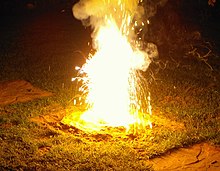
A thermite reaction using fe(3) oxide
Metals, under the correct conditions, burn in a process similar to the combustion of wood or gasoline. (In fact, rust is the result of oxidation of steel or fe at very slow rates.) A thermite reaction results when the right mixtures of metallic fuels combine and ignite. Ignition itself requires extremely loftier temperatures.[32]
Ignition of a thermite reaction normally requires a sparkler or easily obtainable magnesium ribbon, but may crave persistent efforts, every bit ignition tin exist unreliable and unpredictable. These temperatures cannot be reached with conventional blackness powder fuses, nitrocellulose rods, detonators, pyrotechnic initiators, or other common igniting substances.[xvi] Even when the thermite is hot enough to glow bright red, it does not ignite, as information technology must be at or near white-hot to initiate the reaction.[ citation needed ] Starting the reaction is possible using a propane torch if washed correctly.[33]
Ofttimes, strips of magnesium metal are used every bit fuses. Because metals burn without releasing cooling gases, they can potentially burn at extremely loftier temperatures. Reactive metals such as magnesium tin can hands reach temperatures sufficiently high for thermite ignition. Magnesium ignition remains popular among apprentice thermite users, mainly because it can be easily obtained,[sixteen] but a piece of the called-for strip can fall off into the mixture, resulting in premature ignition.
The reaction between potassium permanganate and glycerol or ethylene glycol is used as an alternative to the magnesium method. When these 2 substances mix, a spontaneous reaction begins, slowly increasing the temperature of the mixture until information technology produces flames. The oestrus released by the oxidation of glycerine is sufficient to initiate a thermite reaction.[16]
Apart from magnesium ignition, some amateurs also choose to use sparklers to ignite the thermite mixture.[34] These reach the necessary temperatures and provide enough time before the burning bespeak reaches the sample.[35] This can exist a dangerous method, as the iron sparks, like the magnesium strips, fire at thousands of degrees and can ignite the thermite, though the sparkler itself is not in contact with it. This is specially unsafe with finely powdered thermite.
Match heads fire hot enough to ignite thermite. Utilise of match heads enveloped with aluminum foil and a sufficiently long viscofuse/electric match leading to the lucifer heads is possible.
Similarly, finely powdered thermite can be ignited past a flint spark lighter, every bit the sparks are called-for metal (in this example, the highly reactive rare-earth metals lanthanum and cerium).[36] Therefore, it is unsafe to strike a lighter shut to thermite.
Civilian uses [edit]
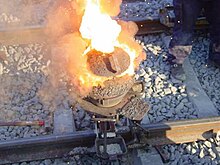
Thermite reaction proceeding for a railway welding: Shortly later on this, the liquid iron flows into the mould around the rail gap

Remains of ceramic moulds for thermite welding like these, left by railway workers near Årstafältet tramway station in Stockholm, Sweden, can sometimes be found along tracks.
Thermite reactions have many uses. Information technology is non an explosive; instead, it operates by exposing a very small area to extremely high temperatures. Intense heat focused on a small spot tin can exist used to cut through metal or weld metal components together both by melting metallic from the components, and by injecting molten metal from the thermite reaction itself.[ citation needed ]
Thermite may exist used for repair by the welding in-place of thick steel sections such as locomotive axle-frames where the repair can take place without removing the part from its installed location.[37]
Thermite tin be used for quickly cutting or welding steel such every bit rails tracks, without requiring circuitous or heavy equipment.[38] [39] However, defects such every bit slag inclusions and voids (holes) are often present in such welded junctions, so bang-up care is needed to operate the process successfully. The numerical analysis of thermite welding of rails has been approached similar to casting cooling analysis. Both this finite chemical element assay and experimental analysis of thermite rail welds has shown that weld gap is the most influential parameter affecting defect formation.[40] Increasing weld gap has been shown to reduce shrinkage cavity formation and cold lap welding defects, and increasing preheat and thermite temperature further reduces these defects. However, reducing these defects promotes a second course of defect: microporosity.[41] Care must also be taken to ensure that the rails remain straight, without resulting in dipped joints, which tin can crusade wearable on high speed and heavy beam load lines.[42]
A thermite reaction, when used to purify the ores of some metals, is chosen the thermite process , or aluminothermic reaction. An accommodation of the reaction, used to obtain pure uranium, was adult as part of the Manhattan Project at Ames Laboratory under the direction of Frank Spedding. It is sometimes called the Ames process.[43]
Copper thermite is used for welding together thick copper wires for the purpose of electric connections. It is used extensively by the electrical utilities and telecommunication industries (exothermic welded connections).
War machine uses [edit]
Thermite manus grenades and charges are typically used by military in both an antimateriel office and in the partial destruction of equipment, the latter beingness common when time is not available for safer or more thorough methods.[44] [45] For example, thermite tin can be used for the emergency destruction of cryptographic equipment when there is a danger that it might be captured by enemy troops. Because standard iron-thermite is difficult to ignite, burns with practically no flame and has a minor radius of activeness, standard thermite is rarely used on its own as an incendiary composition. In general, an increment in the volume of gaseous reaction products of a thermite blend increases the rut transfer charge per unit (and therefore damage) of that detail thermite blend.[46] It is commonly used with other ingredients that increase its incendiary furnishings. Thermate-TH3 is a mixture of thermite and pyrotechnic additives that have been found superior to standard thermite for incendiary purposes.[47] Its composition by weight is generally well-nigh 68.seven% thermite, 29.0% barium nitrate, 2.0% sulfur, and 0.iii% of a folder (such every bit PBAN).[47] The addition of barium nitrate to thermite increases its thermal event, produces a larger flame, and significantly reduces the ignition temperature.[47] Although the principal purpose of Thermate-TH3 past the military machine is equally an incendiary anti-materiel weapon, it besides has uses in welding together metal components.
A classic military machine apply for thermite is disabling artillery pieces, and information technology has been used for this purpose since World War II, such as at Pointe du Hoc, Normandy.[48] Thermite can permanently disable artillery pieces without the use of explosive charges, so thermite can be used when silence is necessary to an operation. This can be washed by inserting one or more armed thermite grenades into the breech, so quickly closing it; this welds the breech shut and makes loading the weapon impossible.[49] Alternatively, a thermite grenade discharged within the butt of the gun fouls the butt, making the weapon dangerous to fire. Thermite can likewise weld the traversing and elevation machinery of the weapon, making proper aiming quite hard.[ citation needed ]
During World War II, both High german and Centrolineal incendiary bombs used thermite mixtures.[50] [51] Incendiary bombs usually consisted of dozens of sparse, thermite-filled canisters (bomblets) ignited by a magnesium fuse. Incendiary bombs created massive impairment in many cities due to fires started by the thermite. Cities that primarily consisted of wooden buildings were especially susceptible. These incendiary bombs were used primarily during nighttime air raids. Bombsights could not be used at night, creating the need to use munitions that could destroy targets without the need for precision placement.
Hazards [edit]

The fierce furnishings of thermite
Thermite usage is hazardous due to the extremely high temperatures produced and the farthermost difficulty in smothering a reaction once initiated. Modest streams of molten fe released in the reaction tin travel considerable distances and may melt through metallic containers, igniting their contents. Additionally, combustible metals with relatively depression boiling points such as zinc (with a boiling betoken of 907 °C, which is about ane,370 °C below the temperature at which thermite burns) could potentially spray superheated boiling metal violently into the air if near a thermite reaction.[ citation needed ]
If, for some reason, thermite is contaminated with organics, hydrated oxides and other compounds able to produce gases upon heating or reaction with thermite components, the reaction products may be sprayed. Moreover, if the thermite mixture contains enough empty spaces with air and burns fast plenty, the super-heated air too may cause the mixture to spray. For this reason it is preferable to utilize relatively rough powders, so the reaction rate is moderate and hot gases could escape the reaction zone.
Preheating of thermite before ignition can hands be done accidentally, for example past pouring a new pile of thermite over a hot, recently ignited pile of thermite slag. When ignited, preheated thermite can burn almost instantaneously, releasing low-cal and oestrus free energy at a much higher charge per unit than normal and causing burns and centre impairment at what would normally exist a reasonably safe distance.[ citation needed ]
The thermite reaction can take identify accidentally in industrial locations where workers employ annoying grinding and cutting wheels with ferrous metals. Using aluminum in this state of affairs produces a mixture of oxides that can explode violently.[52]
Mixing h2o with thermite or pouring water onto burning thermite tin can crusade a steam explosion, spraying hot fragments in all directions.[53]
Thermite'due south master ingredients were also utilized for their individual qualities, specifically reflectivity and heat insulation, in a paint coating or dope for the German language zeppelin Hindenburg, possibly contributing to its fiery destruction. This was a theory put forward by the former NASA scientist Addison Bain, and later tested in small scale past the scientific reality-Television set evidence MythBusters with semi-inconclusive results (it was proven non to exist the mistake of the thermite reaction alone, simply instead conjectured to exist a combination of that and the burning of hydrogen gas that filled the trunk of the Hindenburg).[54] The MythBusters program also tested the veracity of a video plant on the Internet, whereby a quantity of thermite in a metal bucket was ignited while sitting on superlative of several blocks of ice, causing a sudden explosion. They were able to ostend the results, finding huge chunks of ice as far as 50 m from the point of explosion. Co-host Jamie Hyneman conjectured that this was due to the thermite mixture aerosolizing, perhaps in a cloud of steam, causing it to burn even faster. Hyneman also voiced skepticism about another theory explaining the miracle: that the reaction somehow separated the hydrogen and oxygen in the ice and and then ignited them. This explanation claims that the explosion is due to the reaction of loftier temperature molten aluminum with water. Aluminum reacts violently with water or steam at loftier temperatures, releasing hydrogen and oxidizing in the process. The speed of that reaction and the ignition of the resulting hydrogen tin can easily account for the explosion verified.[55] This procedure is akin to the explosive reaction caused by dropping metallic potassium into water.
Come across besides [edit]
- ALICE (propellant)
- Thermal lance – Thermal tool that cuts dense heavy materials
References [edit]
- ^ Wells, John C. (1990). Longman pronunciation dictionary. Harlow, England: Longman. p. 715. ISBN978-0-582-05383-0. entry "thermite"
- ^ Kosanke, One thousand; Kosanke, B. J; Von Maltitz, I; Sturman, B; Shimizu, T; Wilson, G. A; Kubota, N; Jennings-White, C; Chapman, D (December 2004). Pyrotechnic Chemistry — Google Books. ISBN978-1-889526-15-7 . Retrieved 15 September 2009.
- ^ "Demo Lab: The Thermite Reaction". Ilpi.com. Retrieved 11 Oct 2011.
- ^ "Low-Cost Product of Nanostructured Super-Thermites". Navysbir.com. Retrieved 12 October 2011.
- ^ Foley, Timothy; Pacheco, Adam; Malchi, Jonathan; Yetter, Richard; Higa, Kelvin (2007). "Development of Nanothermite Composites with Variable Electrostatic Discharge Ignition Thresholds". Propellants, Explosives, Pyrotechnics. 32 (6): 431. doi:10.1002/prep.200700273. OSTI 1454970.
- ^ "Reaction Kinetics and Thermodynamics of Nanothermite Propellants". Ci.confex.com. Retrieved 15 September 2009.
- ^ Dreizin, Due east. L.; Schoenitz, M. (2017). "Mechanochemically prepared reactive and energetic materials: a review". Journal of Materials Science. 52 (twenty): 11789–11809. Bibcode:2017JMatS..5211789D. doi:10.1007/s10853-017-0912-1. S2CID 136215486.
- ^ Apperson, Southward.; Shende, R. 5.; Subramanian, S.; Tappmeyer, D.; Gangopadhyay, South.; Chen, Z.; Gangopadhyay, K.; Redner, P.; et al. (2007). "Generation of fast propagating combustion and daze waves with copper oxide/aluminum nanothermite composites" (PDF). Practical Physics Messages. 91 (24): 243109. Bibcode:2007ApPhL..91x3109A. doi:10.1063/one.2787972. hdl:10355/8197.
- ^ Goldschmidt, H. (13 March 1895) "Verfahren zur Herstellung von Metallen oder Metalloiden oder Legierungen derselben" (Process for the production of metals or metalloids or alloys of the same), Deutsche Reichs Patent no. 96317.
- ^ "Thermit, Encyclopedia Britannica". www.britannica.com. 30 March 2011. Retrieved 14 August 2022.
- ^ Goldschmidt, Hans; Vautin, Claude (30 June 1898). "Aluminum as a Heating and Reducing Amanuensis" (PDF). Journal of the Society of Chemical Industry. 6 (17): 543–545. Archived from the original (PDF) on 15 July 2011. Retrieved 12 October 2011.
- ^ "Goldschmidt-Thermit-Group". Goldschmidt-thermit.com. Archived from the original on five April 2012. Retrieved 12 October 2011.
- ^ "Thermite Bombs used to Set Fires". The Milwaukee Periodical. ane December 1939. Retrieved 13 October 2011. [ permanent expressionless link ] (expressionless link 25 Apr 2020)
- ^ "what it Means: Thermite Bombing". the Florence Times. 31 Baronial 1940. Retrieved 12 Oct 2011.
- ^ "Hydrogen May Not Have Caused Hindenburg's Peppery Cease". The New York Times. 6 May 1997. Retrieved 12 Oct 2011.
- ^ a b c d eastward "Thermite". Amazing Rust.com. seven February 2001. Archived from the original on 7 July 2011. Retrieved 12 October 2011.
- ^ Koch, Ernst-Christian (2002). "Metallic-Fluorocarbon-Pyrolants: 3. Development and Awarding of Magnesium/Teflon/Viton (MTV)". Propellants, Explosives, Pyrotechnics. 27 (five): 262–266. doi:10.1002/1521-4087(200211)27:5<262::Aid-PREP262>3.0.CO;two-viii.
- ^ Royal Society Of Chemistry. "Burning magnesium in dry ice". Archived from the original on xi December 2021 – via YouTube.
- ^ Swanson, Daren (21 Dec 2007). "Method For Creating Diamonds". world wide web.EnviroDiamond.com. Daren Swanson.
- ^ "Article Prices". IndexMundi. Retrieved 12 February 2015.
- ^ Granier, J. J.; Plantier, G. B.; Pantoya, M. Fifty. (2004). "The function of the Al2O3 passivation shell surrounding nano-Al particles in the combustion synthesis of NiAl". Journal of Materials Science. 39 (21): 6421. Bibcode:2004JMatS..39.6421G. doi:ten.1023/B:JMSC.0000044879.63364.b3. S2CID 137141668.
- ^ Wohletz, Kenneth (2002). "Water/magma interaction: some theory and experiments on peperite formation". Journal of Volcanology and Geothermal Inquiry. 114 (one–2): 19–35. Bibcode:2002JVGR..114...19W. doi:10.1016/S0377-0273(01)00280-iii.
- ^ Sarah Lyall (27 October 2006). "Cameras Catch Speeding Britons and Lots of Grief". The New York Times . Retrieved 12 October 2011.
- ^ a b c K. Kosanke; B. J. Kosanke; I. von Maltitz; B. Sturman; T. Shimizu; Grand. A. Wilson; Northward. Kubota; C. Jennings-White; D. Chapman (December 2004). Pyrotechnic Chemistry. Journal of Pyrotechnics. pp. 126–. ISBN978-1-889526-15-7 . Retrieved 9 January 2012.
- ^ "Manganese thermite based on manganese (II) oxide". Developing your Web presence. 10 July 2008. Retrieved seven December 2011.
- ^ Gupta, Chiranjib Kumar (2006). Chemic Metallurgy: Principles and Exercise. John Wiley & Sons. pp. 387–. ISBN978-3-527-60525-five.
- ^ Elshenawy, Tamer; Soliman, Salah; Hawass, Ahmed (October 2017). "Loftier density thermite mixture for shaped charge ordnance disposal". Defence Technology. 13 (5): 376–379. doi:x.1016/j.dt.2017.03.005.
- ^ "TEC Torch - Energetic Materials & Products, Inc. - Central Texas".
- ^ a b c Fischer, S. H.; Grubelich, M. C. (August 1996). "A survey of combustible metals, thermites, and intermetallics for pyrotechnic applications".
- ^ "Thermite". PyroGuide. 3 March 2011. Archived from the original on six April 2012. Retrieved half-dozen Dec 2011.
- ^ "HTS > News Particular". Hts.asminternational.org. 1 Baronial 2011. Retrieved half dozen Dec 2011.
- ^ Kosanke, Thou. L.; Sturman, Barry T.; Winokur, Robert M.; Kosanke, B. J. (October 2012). Encyclopedic Dictionary of Pyrotechnics: (and Related Subjects). Journal of Pyrotechnics. p. 1114. ISBN978-1-889526-21-8.
- ^ "Richard Nakka's Experimental Rocketry Site". Nakka-rocketry.net. Retrieved 12 Oct 2011.
- ^ "The Globe Today – Virgin Blueish security scare". Abc.net.au. 23 September 2004. Retrieved 12 October 2011.
- ^ Grey, Theodore (19 August 2004). "Making Steel with Beach Sand | Popular Science". Popsci.com. Archived from the original on 8 September 2012. Retrieved 12 October 2011.
- ^ "Material Safety Data Sheet Lighter Flints Ferro Cerrium" (PDF). shurlite.com. 21 September 2010. Archived from the original (PDF) on 24 August 2015. Retrieved 22 January 2012.
- ^ Jeffus, Larry (2012). Welding principles and applications (7th ed.). Clifton Park, N.Y.: Delmar Cengage Learning. p. 744. ISBN978-1111039172.
- ^ "Papers Past — Star — 15 November 1906 — NEW WELDING Procedure". Paperspast.natlib.govt.nz. 15 Nov 1906. Retrieved 12 October 2011.
- ^ "How Many Ways to Weld Metal?". Eugene Annals-Guard. 8 Dec 1987. Retrieved 12 October 2011.
- ^ Chen, Y; Lawrence, F V; Barkan, C P 50; Dantzig, J A (24 October 2006). "Oestrus transfer modelling of rails thermite welding". Proceedings of the Establishment of Mechanical Engineers, Office F: Journal of Rail and Rapid Transit. 220 (three): 207–217. CiteSeerX10.ane.1.540.9423. doi:10.1243/09544097F01505. S2CID 17438646.
- ^ Chen, Y; Lawrence, F V; Barkan, C P L; Dantzig, J A (14 December 2006). "Weld defect formation in rail thermite welds". Proceedings of the Institution of Mechanical Engineers, Part F: Journal of Rail and Rapid Transit. 220 (4): 373–384. CiteSeerX10.one.one.501.2867. doi:10.1243/0954409JRRT44. S2CID 16624977.
- ^ "Strengthening the rails structure for heavy axle loads: strengthening track infrastructure provides another method of dealing with e'er-increasing car capacities. (TTCI R&D)". Goliath Business News. 1 September 2002. Retrieved 12 October 2011.
- ^ US patent 2830894, Spedding, Frank H.; Wilhelm, Harley A. & Keller, Wayne H., "Production of Uranium", issued 1958, assigned to United States Atomic Energy Commission
- ^ "Grenades and Pyrotechnics Signals. Field Manual No 23-30" (PDF). Department of the Army. 27 December 1988. Archived from the original on nineteen Jan 2012.
{{cite web}}: CS1 maint: unfit URL (link) - ^ Pike, John (27 December 1988). "AN-M14 TH3 incendiary hand grenade". Globalsecurity.org. Retrieved 12 Oct 2011.
- ^ Collins, Eric S.; Pantoya, Michelle L.; Daniels, Michael A.; Prentice, Daniel J.; Steffler, Eric D.; D'Arche, Steven P. (15 March 2012). "Heat Flux Analysis of a Reacting Thermite Spray Impingent on a Substrate". Energy & Fuels. 26 (iii): 1621–1628. doi:ten.1021/ef201954d.
- ^ a b c United states of america patent 5698812, Song, Eugene, "Thermite destructive device", issued 1997, assigned to U.s. Secretarial assistant of the Regular army
- ^ "THE INVASION, Chapter 9 THE GUNS OF POINTE-DU-HOC". Pqasb.pqarchiver.com. 29 May 1994. Archived from the original on 24 July 2012. Retrieved 12 October 2011.
- ^ Boyle, Hal (26 July 1950). "Corporal Tells of Gunning of Yank Prisoners". Ellensburg Daily Tape . Retrieved 28 July 2021.
- ^ Noderer, E R (thirty August 1940). "Athenaeum: Chicago Tribune". Pqasb.pqarchiver.com. Archived from the original on 24 July 2012. Retrieved 12 October 2011.
- ^ "Biting Fighting in Great socialist people's libyan arab jamahiriya". The Indian Express. 25 November 1941. Retrieved 12 October 2011.
- ^ "Fireball from Aluminum and Grinding Dust". Hanford.gov. 21 September 2001. Archived from the original on 25 November 2007. Retrieved 15 September 2009.
- ^ "Make Thermite with Iron Oxide and Aluminum". www.skylighter.com . Retrieved 27 January 2017.
- ^ Schwartz, John (21 November 2006). "The Best Science Show on Idiot box?". The New York Times . Retrieved 11 October 2011.
- ^ "Molten Metal Explosions" (PDF). Modern Media Communications Ltd. Retrieved fifteen March 2012. [ permanent dead link ]
Farther reading [edit]
- L. L. Wang, Z. A. Munir and Y. G. Maximov (1993). "Thermite reactions: their utilization in the synthesis and processing of materials". Periodical of Materials Scientific discipline. 28 (14): 3693–3708. Bibcode:1993JMatS..28.3693W. doi:x.1007/BF00353167. S2CID 96981164.
- Chiliad. Beckert (2002). "Hans Goldschmidt and the aluminothermics". Schweissen und Schneiden. 54 (ix): 522–526.
External links [edit]

Expect upwards thermite in Wiktionary, the free dictionary.
- Thermite Pictures & Videos (Including Exotic Thermite)
- Video – steel casting with thermite
- . Encyclopedia Americana. 1920.

Aluminium Powder And Iron Oxide,
Source: https://en.wikipedia.org/wiki/Thermite
Posted by: moorewhatelto44.blogspot.com
0 Response to "Aluminium Powder And Iron Oxide"
Post a Comment